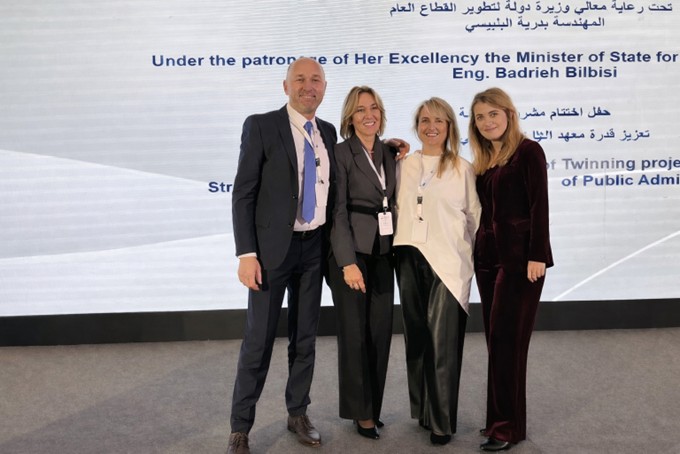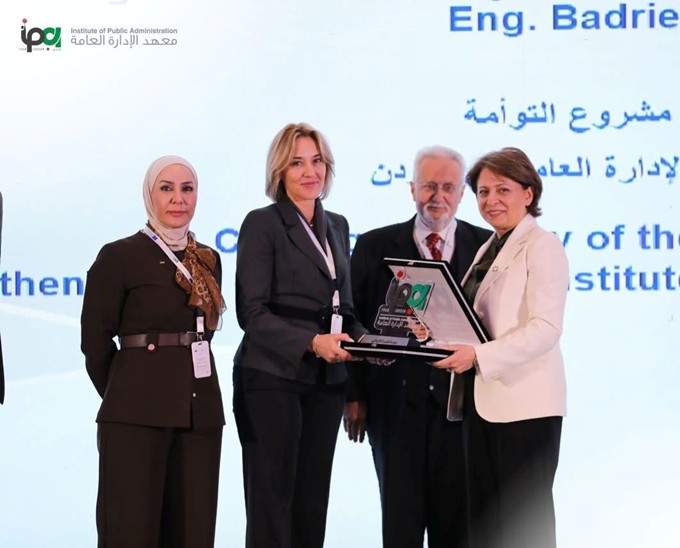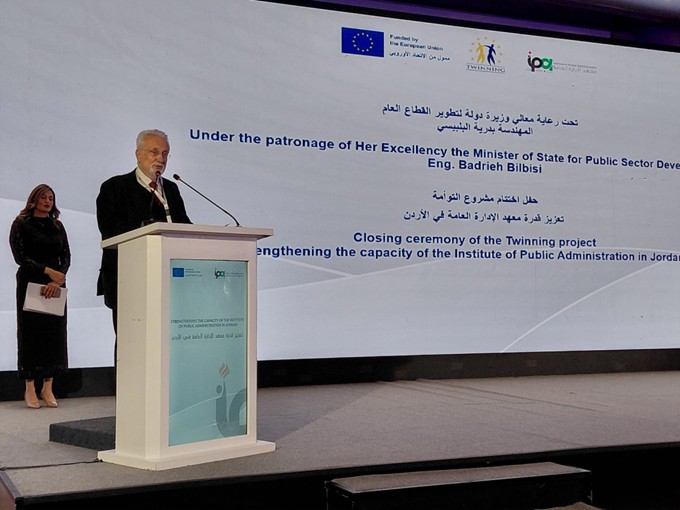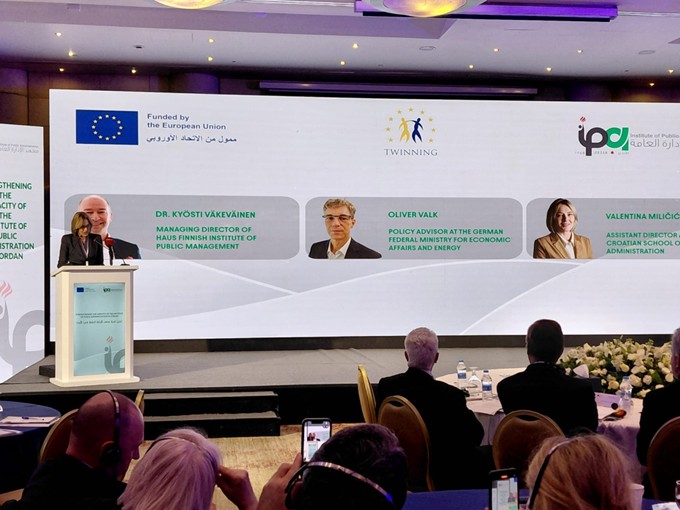


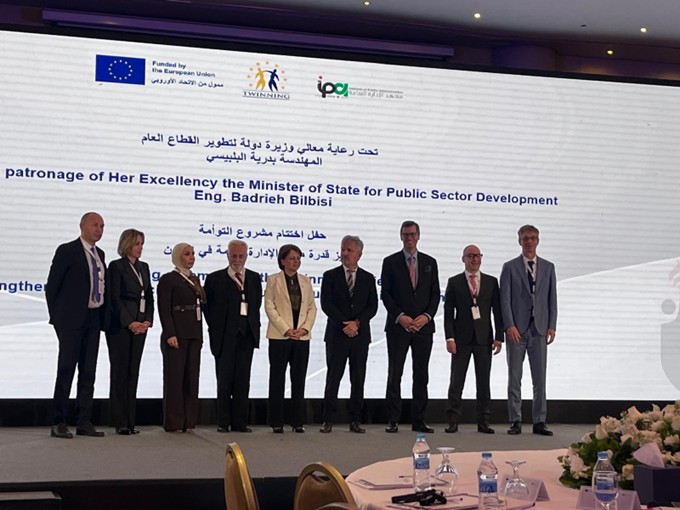
The Twinning Project “Strengthening the Capacity of the Institute of Public Administration in Jordan” was successfully concluded with a closing conference held on 12 February 2026 in Amman.
The project delivered concrete and measurable improvements in the areas of training, evaluation, and institutional development, laying the foundation for the continued strengthening of public administration capacities in the Hashemite Kingdom of Jordan, in line with European and international best practices.
Project activities were implemented through two key components focused on enhancing the learning and development system of the Jordanian Institute of Public Administration (IPA) and developing methodologies for evaluating the effectiveness of IPA’s training programmes.
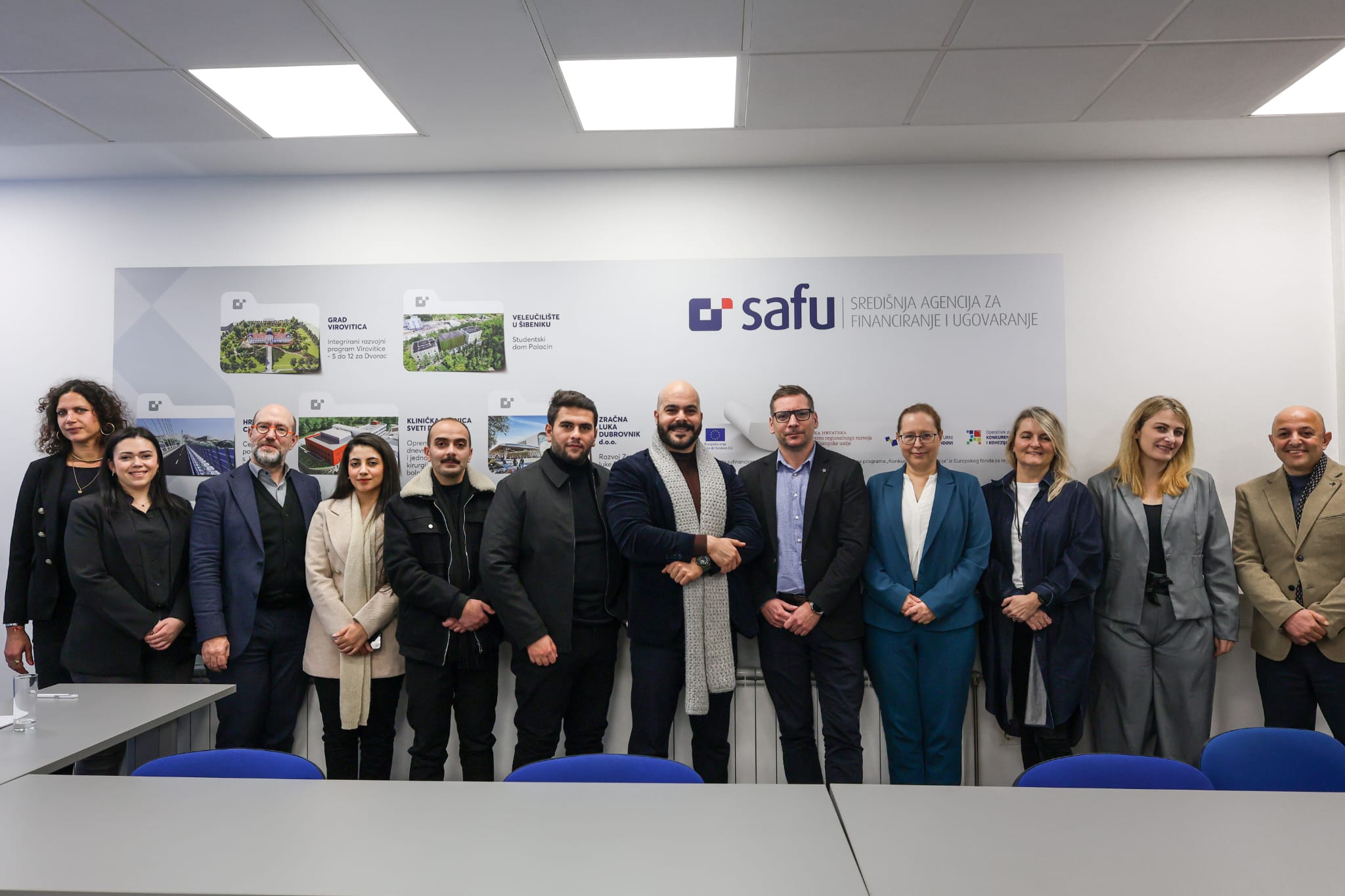
The leading partner of the project was the Finnish Institute of Public Management (HAUS), while the State School for Public Administration of the Republic of Croatia and the Federal Ministry for Economic Affairs and Energy of the Federal Republic of Germany participated as junior project partners. The Croatian Central Finance and Contracting Agency (SAFU) took part in the role of the administrative body, providing administrative and financial support for the implementation of project activities.
The closing ceremony was honoured by the presence of H.E. Tomislav Bošnjak, Ambassador of the Republic of Croatia, who emphasised the importance of international and peer-to-peer cooperation in the field of public administration, highlighting the value of knowledge and experience exchange between European and Jordanian institutions. Valentina Miličić, Assistant Director of the State School for Public Administration and Croatian Junior Project Leader, expressed her gratitude to all project partners and stakeholders, particularly acknowledging the professionalism and dedication of the Jordanian IPA. She stressed that throughout the project, solutions were developed in alignment with the actual institutional and national context, with a strong focus on sustainability and long-term applicability of results.
During the two-year implementation period, activities were directed at strengthening IPA’s core processes of professional development in public administration, particularly in the areas of training needs analysis, evaluation of training outcomes, and reinforcement of institutional accountability. Existing processes were further structured, made measurable, and evidence-based, enabling higher-quality decision-making and more effective management of competency development within public administration.
One of the project’s key outputs is the Evaluation Handbook, which consolidates the methodologies and tools developed during the project and serves as a practical and sustainable reference for the future work of IPA staff.
Finally, a Memorandum of Understanding was signed in Amman between the State School for Public Administration and the Jordanian Institute of Public Administration, establishing a framework for long-term institutional and professional cooperation.
The conclusion of the project therefore marks not only its formal closure, but also the beginning of a new phase of cooperation aimed at preserving the achieved results and further strengthening public administration capacities in Jordan.